There is an old saying in the construction industry that you cannot fake a foundation. You can hide a bad framing job behind drywall or cover cheap plumbing with expensive tile, but if the foundation is compromised, the whole building eventually tells on you. At GAMCON, we have spent years in the trenches (quite literally) around Toronto, and we have seen the good, the bad, and the structurally terrifying.
While helical piles are one of the most versatile and reliable engineering solutions available today, they are not a magic wand. They rely on physics, geology, and precision. When we see helical pile installation mistakes, it is rarely because the steel failed. It is almost always because the human element failed. Whether it is a contractor rushing to finish on a Friday afternoon or a lack of understanding regarding soil mechanics, these errors turn a solution into a nightmare.
We want to pull back the curtain on this process. We believe that an educated client is our best client. If you know what to look for, you can protect your investment and ensure your structure stands the test of time.
Key Takeaways
- Soil Dictates Success: You cannot install piles blindly; understanding the soil bearing capacity is the first step to stability.
- Torque is Truth: Monitoring installation torque is the only way to verify that a pile can hold the weight of your home.
- Precision Matters: Even a slight misalignment in spacing or plumbness can drastically reduce the structural integrity of the foundation.
- Engineering is Non-Negotiable: “Eye-balling” a foundation project is a recipe for disaster; professional oversight ensures code compliance and safety.
What Are Helical Piles and Why Proper Installation Matters
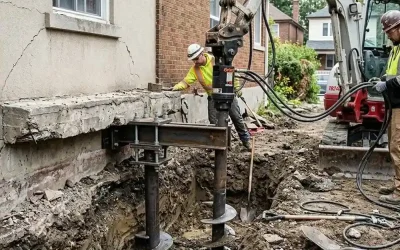
To put it simply, think of a helical pile as a massive steel screw. While a traditional concrete pile relies on friction or end-bearing like a nail hammered into wood, a helical pile is screwed into the ground. The “helices” (the plates welded to the shaft) pull the pile deep into the earth until it reaches stable soil.
This method is brilliant for a few reasons. It is cleaner than pouring concrete, it creates less vibration, and it is usually faster. However, the mechanism that makes them work, transferring the load of your house to deep, stable soil layers, requires absolute precision.
If that load transfer is interrupted or miscalculated, the pile is essentially a steel stick floating in the mud. Proper installation ensures that the weight of the structure is effectively bypassed through the weak surface soil and anchored into the solid strata below.
Helical Piles Installation Mistakes to Avoid
We have compiled the most common errors we see in the field. These are the red flags that lead to helical pile foundation problems and sleepless nights for property owners.
Mistake 1: Skipping Proper Soil Assessment
Why it happens:
Some contractors operate on guesswork. They look at a site, stomp their foot on the ground, and assume they know what is happening ten feet down. They might try to save money by skipping a geotechnical report.
The Consequences:
Soil is tricky. In Toronto, you can have sandy loam on one side of a lot and soft clay on the other. If you install piles without knowing the soil bearing capacity, you are flying blind. This often leads to the piles settling because they never actually reached a layer capable of supporting the building.
How to avoid it:
Always insist on a proper site evaluation. We rely on geotechnical data to determine exactly how deep we need to go to hit the “good stuff.”
Mistake 2: Installing Helical Piles to the Wrong Depth
Why it happens:
This is one of the most frequent helical pile installation errors we encounter. An inexperienced installer might hit a rock or a layer of dense fill and mistake it for the load-bearing stratum. They call it a day, thinking they have hit solid ground.
The Consequences:
If the pile is resting on a floating boulder or a thin layer of hard soil over soft mud (a phenomenon known as “punch-through”), the weight of the house will eventually push the pile through the hard layer into the soft mud beneath. This results in a sudden, significant settlement.
How to avoid it:
We look for consistent resistance. We do not just stop at the first sign of hard work; we verify that we are in the target layer defined by the engineer.
Mistake 3: Ignoring Torque Monitoring Requirements
Why it happens:
Torque is the rotational force required to spin the pile into the ground. There is a direct mathematical correlation between installation torque and load capacity. Some crews either lack the equipment to monitor this or simply ignore the data to speed up the helical pier installation.
The Consequences:
If you do not measure torque, you have zero proof that the pile can hold the weight. It is like baking a cake without setting the oven temperature; you are just hoping for the best. Low torque means low capacity, which equals a sinking foundation.
How to avoid it:
Torque monitoring should be continuous. At GAMCON, we document the torque throughout the installation to prove, mathematically, that the pile meets the required load capacity.
Mistake 4: Incorrect Pile Spacing and Layout
Why it happens:
Trying to save money on materials is usually the culprit here. By spacing piles too far apart, a contractor reduces the total number of piles needed. The other way around, placing them too close together can be just as bad due to “group effect,” where the soil stresses overlap.
The Consequences:
Incorrect spacing creates weak points. If piles are too far apart, the foundation beam between them can crack under the stress. This is often why homeowners seek foundation settlement solutions a few years after a cheap renovation.
How to avoid it:
Stick to the engineering plan. The spacing is calculated based on structural loads and beam strength, not on the contractor’s budget.
Also Read: Guide to Helical Pile Installation for Residential and Commercial Projects
Mistake 5: Using the Wrong Helical Pile Type or Size
Why it happens:
Not all piles are created equal. Using a light-duty residential pile for a heavy commercial load (or vice versa) is a common mismatch. It often happens when a contractor only stocks one type of product.
The Consequences:
A pile that is too small for the job can buckle under the pressure. This is a catastrophic failure mode in which the steel shaft bends or snaps underground. This instantly compromises helical pile load capacity.
How to avoid it:
The pile selection must match the load. We use specific shaft sizes and helix configurations tailored to the specific weight of the structure and the soil type.
Mistake 6: Improper Alignment and Plumbness
Why it happens:
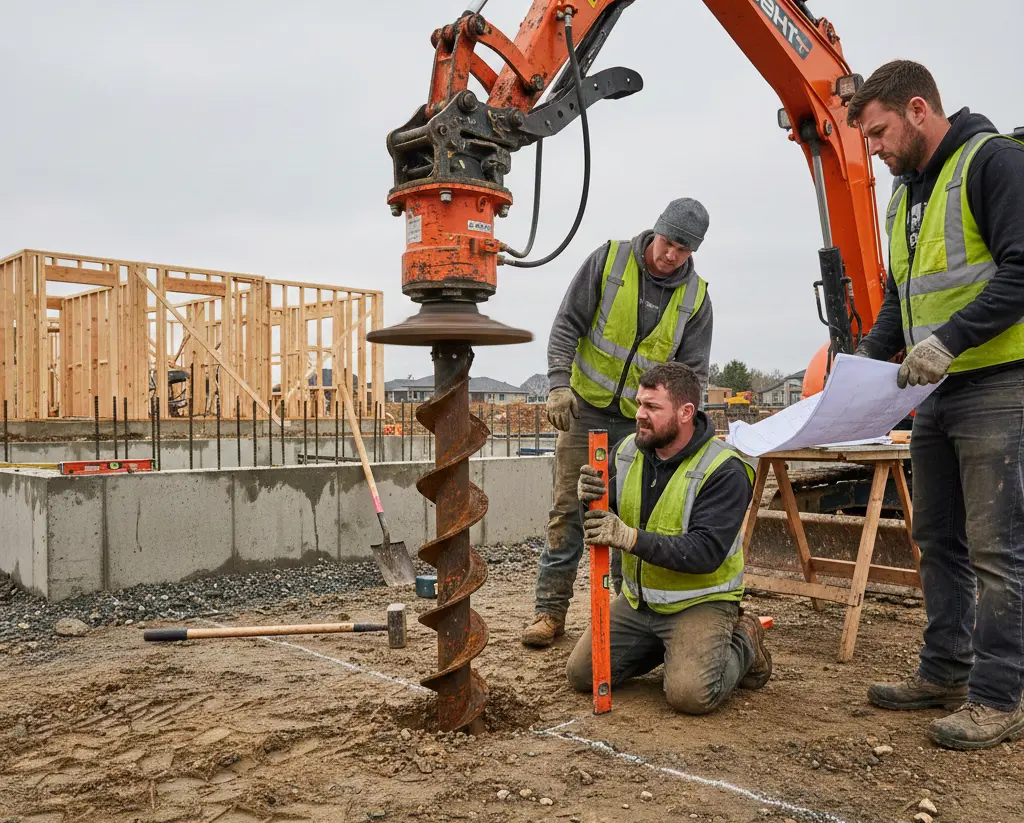
Installing a pile perfectly straight (plumb) requires skill and the right equipment. If the excavator operator is inexperienced, the pile can go in at an angle.
The Consequences:
Helical piles are designed to handle compressive load straight down. If a pile is installed at an angle, gravity introduces lateral forces that the pile was not designed to take. This counts as improper helical pile installation and can cause the foundation to shift sideways or the pile to bend.
How to avoid it:
We use levels and guides throughout the drive process. If a pile starts to walk off-plumb, we correct it immediately or restart the location.
Mistake 7: Poor Connection to the Structure
Why it happens:
The pile is in the ground, but how does it attach to the house? Using makeshift brackets or failing to encapsulate the pile cap in the concrete footing is a shortcut some take.
The Consequences:
Even a perfect pile is useless if it slips out from under the foundation. Poor connections lead to differential movement, where the pile stays still, but the house moves off it.
How to avoid it:
We use engineered brackets and caps designed specifically for the pile system. The connection must be as strong as the pile itself.
Mistake 8: Installing Without Engineering Oversight
Why it happens:
Navigating permits and hiring engineers adds time and cost. Some “fly-by-night” operators try to bypass this to offer a lower price, acting as a foundation repair contractor that Toronto homeowners should avoid.
The Consequences:
Aside from the legal headache of unpermitted work, you lose the safety net of professional liability. If an engineer didn’t stamp the drawing, there is no guarantee the design is sound.
How to avoid it:
Never proceed without engineered drawings. It protects you, your property, and your resale value.
Lessons from the Field: Real-World Consequences of Bad Installations
We once visited a property in the GTA where a homeowner had hired a general landscaper to install piles for a large sunroom addition. The price was “unbeatable.” Two years later, the sunroom had pulled away from the main house by three inches.
When we excavated to investigate, we found the piles were barely five feet deep, resting in soft topsoil. The “savings” the homeowner made on the installation were wiped out instantly. They had to pay for demolition, new engineering, and a complete reinstall. It is a heartbreaking situation, but it reinforces a truth we live by: cheap work is expensive.
Also Read: How Much Does Helical Piles Installation Cost in Toronto?
How to Tell If Helical Piles Were Installed Incorrectly
Your house speaks to you; you just have to listen. Signs of helical pile foundation repair needs include:
- New Drywall Cracks: Specifically around doors and windows, often diagonal.
- Sticking Doors: If a door that used to close essentially swings open or jams, the frame has shifted.
- Uneven Floors: You might feel dips or slopes as you walk.
- Gaping Exterior: Separation between brickwork or siding.
If you notice these issues shortly after an installation, do not wait. Immediate assessment can sometimes save the structure before it fails completely.
How Professional Installation Prevents These Mistakes
At GAMCON, we view installation as a science. We do not guess. By strictly adhering to the “Check, Verify, Document” protocol, we eliminate the variables that lead to failure. We utilize calibrated drive heads to measure torque to the foot-pound. We maintain logs for every single pile that goes into the ground.
This isn’t just paperwork; it is peace of mind. When we leave a site, we know exactly what that foundation can hold, and we have the data to prove it.
Helical Piles vs Other Foundation Solutions
We love helical piles, but they aren’t the answer to every single problem. When comparing helical piles vs underpinning, for example, the context matters. Underpinning (strengthening the existing foundation by digging beneath it and pouring concrete) is fantastic for increasing basement height or for working in extremely tight spaces where machinery cannot fit.
However, for deep foundation support in poor soil, or for rapid installation with minimal mess, helical piles usually win. The key is knowing when to use which tool. We are never afraid to tell a client that piles might *not* be the right fit if concrete makes more sense.
Why Choose GAMCON for Helical Pile Installation
When you hire GAMCON, you are hiring a team that views your foundation as the most critical part of your asset. We combine field-tested expertise with rigorous engineering standards to ensure that once a pile is in the ground, it stays there. We have successfully navigated complex soil conditions across Toronto, delivering results for both residential and commercial projects. We don’t just sell piles; we sell stability. Our commitment to transparency means you will understand every step of the process, from the initial torque reading to the final bracket connection.
Building on Solid Ground: The Value of Doing It Right
We hope this look into the mechanics of our trade has been helpful. It is easy to look at a quote and wonder why one number is higher than another, but when you factor in the cost of helical pile installation mistakes, the value of hiring a specialist becomes clear.
Your home is likely your biggest investment. Protecting it requires more than just steel; it requires expertise, honesty, and a refusal to cut corners. Whether you are planning a new addition or fixing a sinking corner, you deserve a foundation that lets you sleep soundly at night.
Is your foundation showing signs of distress, or are you planning a project and want to ensure it starts on the right foot? Contact GAMCON today for a comprehensive site assessment, and let’s build something that lasts.