Choosing the right foundation is one of the most critical decisions in any construction project. It is the literal bedrock of your investment, yet it is often the most stressful part of the planning phase because your house literally can remain stable or fall based on your decision. Two of the most common deep foundation options, helical piles and drilled shafts (often called caissons), are often compared but misunderstood. It can feel a bit like comparing apples to oranges if you aren’t familiar with the engineering beneath the surface.
To bring everything to the same page, we’ve put together this guide to break down the real differences between these systems, explain when each performs best, and help you determine which foundation is the right fit for your project’s soil, schedule, and structural requirements.
Key Takeaways
- Speed: Helical piles can be loaded immediately after installation, whereas concrete caissons require curing time.
- Site Impact: Drilled shafts produce significant soil “spoils” that must be removed; helical piles are a displacement technology creating zero spoils.
- Capacity: While caissons can achieve massive load capacities for high-rise structures, helical piles are often more efficient for low-to-mid-rise residential and commercial projects.
- Conditions: High water tables can complicate drilled shaft installation, whereas helical piles generally perform consistently regardless of groundwater levels.
Understanding Deep Foundation Systems
Before we dive into the specific battle of helical piles vs caissons, we need to look at why we are digging deep in the first place. Why not just pour a slab and call it a day?
In an ideal world, every construction site would have solid bedrock sitting right at the surface, and everything would be stable from here until eternity. In reality, especially here in the GTA and Southern Ontario, we often encounter loose sand, soft clay, or fill material that simply cannot support the weight of a new structure. This is where deep foundation systems come into play.
The primary goal is to bypass those weak, compressible surface layers and transfer the building’s weight to a stronger, more stable layer of soil or bedrock deeper down. This process, known as foundation load transfer, ensures that your building doesn’t settle, shift, or crack over time. Think of it like stilts walking through mud; the stilts go down until they hit solid ground, keeping the person above dry and stable. Both helical piles and drilled shafts achieve this, but they go about it in vastly different ways.
What Are Helical Piles?
If you have ever used a screw to hang a heavy picture frame or secure a deck board, you already understand the basic mechanical principle of a helical pile.
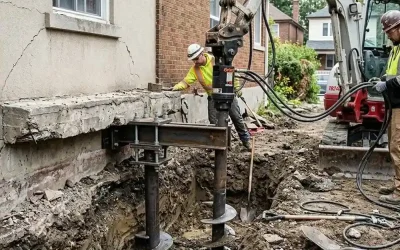
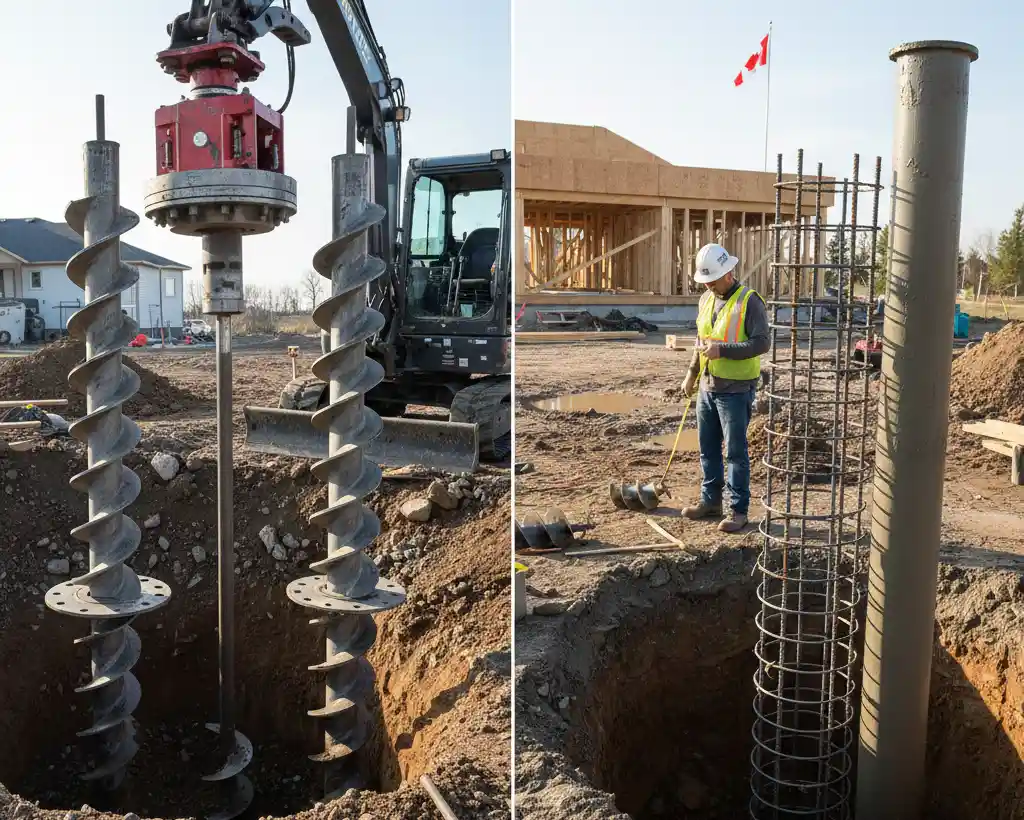
A helical pile is a manufactured steel foundation pin. It consists of a central steel shaft with one or more helix-shaped plates (the “flights”) welded to it. Instead of digging a hole and filling it, the pile is mechanically “screwed” into the ground using hydraulic machinery. As the pile rotates, the helical plates pull the shaft deep into the soil, anchoring whatever is above.
These are not new inventions either, but modern technology has turned them into highly precise structural foundation systems. We measure torque (rotational force) during installation, providing real-time data on soil bearing capacity. Once the pile reaches the target torque and depth, we stop.
The beauty of this system is its clean installation. Because the pile screws into the ground, it displaces the soil rather than removing it. This means no piles of dirt to truck away and no gaping holes left open on your job site. They are commonly used for everything from residential additions and underpinning to commercial boardwalks and industrial equipment pads.
What Are Drilled Shafts (Caissons)?
On the other side of the ring, we have drilled shafts, commonly referred to in the industry as caissons, which are what many of us typically know as foundations for big buildings. If a helical pile is a screw, a drilled shaft is a massive concrete column.
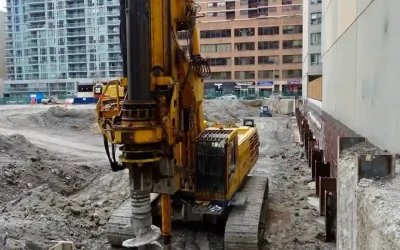
The construction of caisson foundations is more of a brute-force method. A large drilling rig augers a cylindrical hole into the ground to the required depth. As the drill pulls up, it removes soil, creating a void. Once the hole is drilled, a cage of steel reinforcement (rebar) is lowered in, and the hole is filled with concrete.
Drilled shafts rely on two things for strength: “end bearing” (the bottom of the concrete column sitting on hard soil or rock) and “skin friction” (the friction between the rough concrete sides and the surrounding soil). They are incredibly strong and rigid. You will see these used frequently in heavy infrastructure projects, high-rise condos in downtown Toronto, and large bridge abutments where the loads are enormous. However, for many mid-sized projects, they might be akin to using a sledgehammer to crack a walnut.
Key Differences Between Helical Piles and Drilled Shafts
To make the best decision, you need to look beyond just the materials and understand how the installation impacts your site.
Installation process
The difference in machinery is night and day. Helical piles can be installed using smaller equipment, such as a skid steer or a mini-excavator. This makes them significantly quieter and produces less vibration. You won’t be rattling the neighbour’s china cabinet during installation.
Drilled shafts generally require heavy, dedicated drilling rigs. These machines are loud, large, and create significant ground vibration. Furthermore, the process is messy. You are bringing wet concrete on-site, dealing with rebar cages, and managing heavy machinery traffic.
Soil conditions and performance
Soil is rarely consistent. One foot you are in clay, the next you hit a boulder, and across the GTA, you’ll find all kinds and types of soil, sometimes within the same block.
In drilled shafts, groundwater is the enemy. If you drill a hole below the water table, it can fill with water, or the sides can collapse (sloughing). This requires using temporary steel casings or drilling slurry to keep the hole open, which complicates the process and drives up costs.
Helical piles, conversely, don’t care much about water. Since there is no open hole, groundwater doesn’t affect the installation or the capacity. However, helical piles can struggle in extremely rocky soil or soil with large debris, as the helix plates can get damaged or hung up on obstructions.
Construction timeline
Time is money in construction. With helical piles, you get immediate gratification. As soon as the pile is in the ground, you can cap it and build on it. There is no waiting.
Concrete caissons require patience. After pouring, you must wait for the concrete to cure and reach its design strength before you can apply a load. This can pause your vertical construction for days or even weeks, depending on the weather and mix design.
Site access and space limitations
Have you ever tried to park a moving truck in a tight downtown Toronto laneway? Now imagine trying to fit a massive drilling rig in there.
Construction site access limitations are often the deciding factor. Helical piles excel in tight spaces. If we can fit a mini-excavator through a gate or doorway, we can likely install piles. Drilled shafts require significant overhead clearance and a large footprint for the rig and the concrete trucks. For retrofits inside existing buildings or tight urban lots, drilled shafts are often logistical nightmares.
Cost Considerations (What Actually Drives the Price)
This is the section most project managers skip to first. Is one cheaper than the other? The answer is the classic engineer’s response: “It depends.” However, looking at the price per unit is a trap. You have to look at the total project cost.
Drilled shafts might seem cheaper on paper when viewed strictly in terms of material volume. Concrete is relatively inexpensive. However, the hidden costs can bite you.
- Mobilization: Getting a large drill rig to the site is expensive.
- Spoils: This is the big one. Drilling a 20-foot-deep, 2-foot-wide hole produces a lot of dirt. In urban areas, that dirt is often considered “contaminated” until proven otherwise, meaning you pay a premium to truck it away and dispose of it.
- Concrete Overages: If the soil is soft, the hole might bulge, requiring more concrete than calculated.
Helical piles usually have a fixed price per pile. There is no soil to remove (huge savings), mobilization is cheaper, and there is no concrete to buy or test. For light to heavy residential and commercial loads, helical piles often come out ahead on the final balance sheet because they eliminate the unpredictable variables of excavation and disposal.
Also Read: How Much Does Helical Piles Installation Cost in Toronto?
Which Foundation Is Better for Your Project?
Let’s try to simplify the decision matrix.
Helical piles are likely your best bet if:
- You are working on a timeline and cannot wait for the concrete to cure.
- The site has limited access or is in a dense residential area.
- You want to avoid the mess and cost of soil disposal.
- The water table is high.
- You are building a residential addition, a deck, or a low-rise commercial structure.
Drilled shafts make more sense if:
- You are building a massive structure (like a condo tower) with immense vertical loads.
- The soil is extremely rocky or contains significant obstructions that would block a helix.
- You need to resist massive lateral (sideways) loads that require the sheer mass of a concrete column.
- Access and noise are not limiting factors.
Sometimes we even see foundation design considerations that use both systems in different areas of the same project, leveraging the strengths of each.
Also Read: Common Myths About Helical Piles
Common Misconceptions About Helical Piles and Caissons
Let’s clear the air on a few myths that persist in the construction trailer.
“Helical piles are only for light structures like decks.”
False. Modern helical piles are engineering marvels capable of supporting hundreds of tons. We regularly use them for multi-story buildings and industrial applications. They are far more than just “ground screws.”
“Caissons are always stronger.”
“Stronger” is relative. A caisson might have a higher ultimate capacity limit, but if your building doesn’t need that much capacity, you are paying for strength you won’t use. It is like buying a semi-truck to pick up groceries.
“One system is always cheaper.”
As mentioned above, soil conditions dictate the cost. A cheap caisson quote can double if you hit groundwater. A helical pile quote is usually firm because the variables are controlled.
“Soil conditions don’t change the decision much.”
Soil is everything. Ignoring the soil report is the fastest way to blow a budget. You cannot force a foundation system into the wrong geology without paying a steep price.
Also Read: Square Shaft vs Round Shaft: Choose Right Helical Pile for Your Project
How GAMCON Helps Clients Choose the Right Foundation System
At GAMCON, we don’t just show up and start digging. We believe that the best foundation is the one you don’t have to worry about. We approach every project by looking at the specific constraints you face.
We work directly with your geotechnical and structural engineers to review the soil logs and load requirements. We understand the local geography of the Greater Toronto Area, from the sandy soils near the lake to the dense clays further north. Whether your project calls for the surgical precision of helical piles or the brute strength of drilled shafts, we provide impartial, practical recommendations.
Our goal is to reduce your risk. Nobody likes a surprise bill for “unforeseen ground conditions” or a schedule delay caused by a concrete truck stuck in traffic. By evaluating the structural foundation systems early in the design phase, we help you lock in a plan that is buildable, budget-friendly, and safe.
Building on Solid Ground: Your Next Step
There is no universal “best” foundation, only the best foundation for your specific project conditions. By understanding how helical piles and drilled shafts differ in performance, installation, and cost, you can make an informed choice that supports long-term structural success.
The right decision early in the process helps prevent delays, redesigns, and unnecessary expense. You wouldn’t build a house without a blueprint, so don’t choose a foundation without a strategy.
Talk to GAMCON about choosing the right foundation system for your project before construction begins. We are ready to help you evaluate your site and get your project off the ground efficiently.