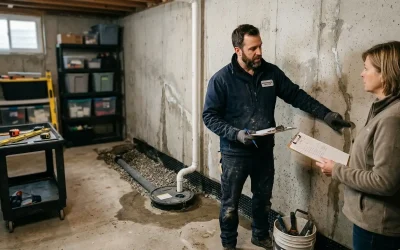
Many homeowners notice cracks, uneven floors, or doors sticking before realizing their foundation may be settling. It is a stressful realization, isn’t it? You might be enjoying a quiet morning in your Toronto home when you suddenly notice that the hairline crack above the living room doorframe has grown, or your favourite coffee cup starts sliding slightly across the kitchen island. Foundation settlement is a serious issue that can make any property owner lose sleep, but do not panic just yet.
Helical piers are one of the most reliable solutions for stabilizing foundations. Think of them as the heavy lifters of the structural world, quietly doing the hard work beneath the surface to keep your home safe, level, and secure. However, one of the most common questions homeowners ask is: “How many helical piers do I need?”
It is a completely fair question. After all, nobody wants to pay for more hardware than they require, but skimping on foundation support is a guaranteed recipe for future disaster. The simple truth is that the answer depends on several structural and soil factors. You cannot just guess a number, cross your fingers, and hope the house stays put. In this guide, we are going to break down the science of foundation stabilization. We will explain exactly how engineers determine pier count, giving you a clear look at the calculations behind the scenes.
Key Takeaways
- Every House is Unique: There is no magic number. Your home’s specific weight, layout, and soil conditions dictate the exact number of piers required.
- Engineering Matters: Professionals use precise structural load calculations and soil bearing capacity tests to design your custom system.
- Spacing is Strategic: Piers are generally spaced 5 to 8 feet apart, depending heavily on the foundation design and load distribution.
- Quality Over Quantity: Installing the correct number of correctly sized piers with precise torque monitoring is always better than simply adding more cheap piers.
What Are Helical Piers and How Do They Support Foundations?
Before we dive into the math, let us define what we are actually working with. Helical piers, also known as screw piles, are heavy-duty steel shafts with spirally wound plates attached to them. Imagine a massive, industrial-grade screw designed to be twisted deep into the earth.
Using a powerful hydraulic drive motor attached to an excavator, these piers are driven deep into the ground until they reach the stable ground beneath the weak, shifting topsoil. They keep going until they hit dense, load-bearing soil or solid bedrock. Once they reach that stable layer, they act as permanent stilts for your home. Underpinning brackets are then attached to the foundation footing, effectively transferring the weight of your structure from the unstable soil onto the deep, secure screw piles.
You will see these systems utilized everywhere in both residential and commercial foundations. Why are they so popular? They are widely used for foundation repair and new construction because they are incredibly efficient, create minimal site disturbance, and provide immediate load-bearing capabilities. There is no waiting for the concrete to cure. Once they are in the ground, they are ready to hold up your house.
Quick Answer – Typical Number of Helical Piers for a Foundation
If you are just looking for a ballpark figure to wrap your head around the scope of your project, we can provide some general estimates. Keep in mind that how many piers for foundation repair you will need is ultimately decided by a structural engineer, but here is what we typically see in the field.
| Project Scope | Typical Pier Count | Scenario |
| Minor Repairs | 4 to 6 piers | Localized settlement, like a sinking chimney or a sagging corner of an attached garage. |
| Average Stabilization | 6 to 12 piers | A standard residential home experiencing settlement along one or two main foundation walls. |
| Large Structures | 10+ piers | Expansive homes, severe total-home settlement, or heavy multi-story buildings requiring full perimeter support. |
| Decks & Additions | 3 to 8 piers | Supporting a new deck, sunroom, or a heavy structural home addition. |
Why do these numbers vary so wildly from project to project? It comes down to the weight of the building and the strength of the earth beneath it. Let us look at how the professionals figure that out.
Also Read: Guide to Helical Pile Installation for Residential and Commercial Projects
How Engineers Calculate the Number of Helical Piers Needed
Designing a helical pier foundation design is not a guessing game. It is a strict mathematical process. Here is the step-by-step breakdown of how engineers arrive at your final pier count.
Step 1: Determine Structural Load
First, we need to know exactly how much weight needs to be supported. Engineers look at the structural load, which is divided into two categories:
- Dead Load: The permanent weight of the building itself. This includes the concrete foundation, the lumber framing, the roof shingles, and the drywall.
- Live Load: The temporary or changing weight. This includes furniture, people walking around, and, importantly for us in Canada, the heavy weight of snow sitting on your roof during the winter months.
By calculating the dead load and live load, the engineer determines the total building weight that the foundation must support.
Step 2: Evaluate Soil Conditions
A heavy house needs strong dirt. Engineers will often review a geotechnical report to understand the soil type on your property. Are we dealing with dense gravel, soft clay, or loose sand? The soil bearing capacity tells the engineer exactly how much weight the earth can naturally support before it starts to give way. Geotechnical testing takes the mystery out of what is happening below your lawn.
Step 3: Calculate Pier Load Capacity
Next, the engineer determines the helical pile load capacity. This involves choosing the right pier shaft diameter and configuring the helix plates (the spiralled blades) to match the soil conditions. During installation, our crew utilizes precise torque monitoring. The concept of torque correlation is fascinating: the harder the hydraulic drive motor has to work to twist the pier into the ground, the more weight that pier is scientifically proven to hold.
Step 4: Apply Engineering Safety Factors
Finally, a structural engineer applies strict safety margins. If a section of your house weighs 10,000 pounds, an engineer will not design a system that holds exactly 10,000 pounds. They will build in a robust safety factor to ensure the system can handle unexpected shifts. They also calculate the load distribution across piers so that no single pile is doing all the heavy lifting alone.
Typical Helical Pier Spacing Guidelines
So, how far apart do these giant steel screws need to be? The industry spacing range is typically between 5 and 8 feet apart.
However, helical pier spacing is not a one-size-fits-all rule. The exact distance is heavily influenced by a few critical factors. Heavy structural loads, like a multi-story brick chimney or an oversized garage, require piers to be placed much closer together to handle the intense, concentrated weight. Weak soils also dictate tighter helical pile spacing requirements, as the soil cannot assist in bridging the gap between the piles. Furthermore, if the foundation stabilization plan involves active lifting operations (actually jacking the house back up to its original level rather than just stabilizing it in place), the piers must be spaced closely enough to prevent the concrete foundation from cracking under the stress of the lift.
7 Key Factors That Determine How Many Helical Piers You Need
If you are wondering why your neighbour needed six piers and you need ten, it boils down to these seven unique variables:
- Extent of foundation settlement: A home that has dropped three inches requires more comprehensive support than a home that has settled half an inch.
- Soil conditions and stability: Soft, yielding soil requires a higher density of piles to distribute the structure’s weight safely.
- Foundation type: A heavy basement foundation, a concrete slab, and a crawlspace all distribute weight differently, altering the pier layout.
- Total structure weight: A three-story brick home weighs substantially more than a single-story vinyl-sided bungalow.
- Helical pier load capacity: Stronger, larger-diameter piers can hold more weight, sometimes reducing the total number of piers needed.
- Building layout and geometry: Homes with complex footprints, multiple bay windows, or bumped-out additions have uneven load points that require customized support.
- Repair vs. New Construction: A brand-new residential helical pile foundation is usually engineered from day one, whereas retrofitting foundation repair helical piers onto an older, damaged structure requires careful, strategic placement to halt further movement.
Real-World Examples of Helical Pier Layouts
Sometimes, abstract engineering concepts are easier to understand with practical examples. Here is how these projects typically unfold in the real world.
Example 1: Typical 1,800 sq ft home foundation stabilization
Imagine a standard suburban home in Toronto where the entire back wall has begun to sink, jamming the rear windows. To stabilize this 40-foot span of foundation wall, an engineer might specify piles spaced at 6-foot intervals. This would require roughly 7 to 8 helical piers to adequately distribute the weight and lift the wall back into place.
Example 2: Corner settlement repair
Water from a broken downspout pools at the front right corner of a house, washing away the soil and causing that specific corner to drop. Because this is a highly localized issue, the repair might only require 3 or 4 piers placed tightly around that specific corner to lock it onto stable soil.
Example 3: Deck or home addition support
You are building a heavy, multi-level composite deck. Instead of pouring traditional concrete footings that might heave in the winter, you use screw piles for foundation support. A large deck might require 6 evenly spaced piers to carry the live load of the structure and the people on it.
How Soil Conditions Affect Helical Pier Requirements
Soil is arguably the most unpredictable factor in construction. Mother Nature has a funny way of reminding us who is boss, and the earth beneath our feet is rarely uniform.
Expansive clay soils are notorious for causing foundation nightmares. When clay gets wet, it swells like a sponge, pushing against your foundation. When it dries, it shrinks, causing the house to settle. If you have expansive clay, you might need more piers driven deeper to completely bypass this active zone. Sandy soils, on the other hand, drain well but can wash away easily, requiring deep penetration to find a dense, load-bearing layer.
If your home was built on improperly compacted fill soil (dirt brought in from elsewhere to level a lot), it is essentially sitting on a fluffy mattress. You will need piles that reach past the fill soil into virgin earth. Bedrock or shallow rock layers provide fantastic support, often requiring fewer, but specialized, piles. Finally, living in Canada means we have to respect the frost depth. Frost heave can destroy a foundation. Helical piers must always be installed well below the local frost line to prevent freezing groundwater from pushing the piles upward during our freezing winters.
Cost Impact – Does More Piers Mean Higher Project Cost?
Let us talk about the bottom line. The average cost per helical pier can vary based on the required depth and the specific bracket, but naturally, requiring more piers will increase the total cost of materials and labour for your helical pile installation.
Installation factors that affect price include the ease of access for our excavators, the depth we need to drill to reach stable soil, and the complexity of engineering and equipment considerations. It is tempting to look at a quote and ask if you can just remove a pier or two to save some cash. Do not put the cart before the horse! Trimming the pier count means stretching the spacing beyond the engineer’s recommendations. Proper pier spacing prevents costly future repairs. Spending a little more today to do it right is far cheaper than dealing with a failed foundation five years down the road.
Also Read: Understanding Load Capacity: How Much Weight Can Helical Piles Really Support?
How Professionals Determine the Exact Number of Piers
At this point, it should be clear that you cannot eyeball a foundation issue and guess the solution. Professionals determine the exact number of piers through a rigorous process. It starts with a thorough structural inspection to map out the damage. This is followed by detailed soil analysis and precise load calculations.
The culmination of this data is a final pier placement plan stamped by an engineer. This is exactly why DIY estimates or taking advice from an uncertified contractor is unreliable. Foundation work requires specialized physics and geology. Always trust the math.
Why Choose GAMCON for Helical Pier Installation
When your home is quite literally on the line, you need a team you can implicitly trust. GAMCON is a team of experienced foundation specialists dedicated to protecting your greatest investment. We do not guess; every single project we undertake features an engineering-backed design tailored to your specific property. We utilize modern installation equipment to ensure your site is treated with respect and the job is done efficiently. From minor residential fixes to major commercial undertakings, we deliver proven stabilization results that stand the test of time and the harsh Canadian elements.
Anchoring It All Together: A Recap on Helical Pier Requirements
Dealing with foundation settlement is stressful, but understanding the solution brings peace of mind. We have explored how the structural load of your home, the unique soil conditions of your property, and strict engineering safety factors all combine to dictate exactly how many helical piers your project requires. Whether you need four piers for a sinking corner or twelve for a major wall stabilization, the goal remains the same: bypassing weak soil to permanently anchor your home to solid ground. Remember, optimal spacing and professional load calculations are the keys to a lasting repair.
If you are tired of watching those drywall cracks expand and want a permanent, scientifically proven solution, we are here to help.