Foundation problems rarely start with dramatic failures or loud noises. They usually begin quietly. You might notice small cracks, subtle floor slopes, or doors that do not close quite right, but often those can be easily explained away. Many homeowners overlook these early signs, unaware they often indicate deeper soil issues or foundation instability. It is easy to dismiss a sticking window as just humidity, isn’t it? However, ignoring these hints can lead to significant headaches down the road.
This guide explains the key warning signs that your home may need helical piles, how to tell if movement is progressing, and when early action can prevent costly structural foundation damage.
Key Takeaways: Stabilizing Your Home and Peace of Mind
- Subtlety is Key: Early signs of foundation failure, like hairline cracks or sticking doors, are often mistaken for normal settling or cosmetic issues.
- Root Cause Matters: Foundation settlement is usually caused by unstable soil. Treating the symptom (patching cracks) without fixing the soil issue (helical piles) is a temporary fix.
- Proactive vs. Reactive: Addressing signs of foundation problems early often costs significantly less than waiting for major structural failure.
- Expert Diagnosis: Not every crack requires a pile. A professional structural engineer assessment ensures you only pay for the repairs you actually need.
What Are Helical Piles and Why They’re Used in Foundation Repair
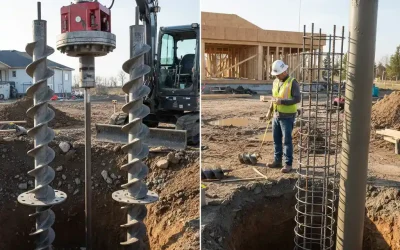
Before we dive into the symptoms, let us look at the cure. You can think of helical piles (also known as helical piers) as giant screws made of galvanized steel. Unlike traditional concrete footings that sit on top of the soil, these piles are drilled deep into the ground.
And this concept is surprisingly simple yet incredibly effective. The piles are torque-driven into the earth until they reach a load-bearing soil layer or bedrock that is stable enough to support your home. Once they hit that solid ground, they effectively bypass the shifting, weak soil near the surface.
This allows the weight of your home to be transferred from the unstable surface soil to the secure helical piles. It’s the difference between trying to stand on a soft mattress versus standing on a concrete floor. This method is used for stabilization, preventing your home from sinking further, and can often be used to lift the foundation back to its original position, which is a win-win situation. Helical piles have become the go-to solution for everything from century-old Victorian homes in Toronto to modern additions on tricky soil.
Early Warning Signs Your Home May Need Helical Piles
Recognizing the early indicators of trouble is the best way to protect your investment. The goal here is not to panic but to be observant.
Interior signs to watch closely
Your home’s interior is often the first place to reveal secrets about what is happening underground. Keep an eye out for cracks in walls and foundation areas that seem to appear out of nowhere. Specifically, look for hairline cracks above door frames or windows. These are stress points in the wall structure.
Drywall separation is another telltale sign. If you see tape peeling or nail pops (where the drywall nails push out through the paint), it suggests the framing behind the wall is twisting or shifting. Additionally, pay attention to your doors and windows. Are they sticking seasonally? While some wood expansion is normal in our humid Canadian summers, a door that suddenly jams or a window that refuses to lock often indicates that the window or door frame has become out of square due to foundation settlement.
Floor and framing indicators
Have you ever walked down your hallway and felt like you were heading downhill? Uneven or sloping floors are one of the most reliable indicators of foundation issues. You can test this easily. Place a marble or a small ball on the floor. If it rolls to one side immediately, you have a gradient that needs investigation.
Beyond the slope, listen to your house. Bouncing or sagging sections of the floor can indicate that the joists or beams below have lost support. You might also notice gaps opening up between the baseboard trim and the floor, or between the crown moulding and the ceiling. When the house moves, the pretty finishes tend to pull apart, waving red flags.
Exterior clues homeowners often miss
Walk around the perimeter of your house. What you are looking for here are stair-step cracks in brick or block work. Because masonry is rigid, it cannot flex when the foundation settles. Instead, it cracks in a zig-zag pattern along the mortar lines.
Check your porch, chimney, or concrete steps. Are they pulling away from the main structure? This separation usually happens because the lighter addition (the porch) and the heavier house are settling at different rates. Finally, look at the exposed concrete at the base of your home for small but widening foundation cracks. Vertical cracks can sometimes be due to shrinkage, but horizontal or diagonal cracks usually indicate that the soil is pushing or pulling the structure.
Also Read: Helical Piles vs. Push Piers
Signs That Indicate Foundation Movement Is Progressing
There is a difference between a house that settled slightly twenty years ago and stopped, and a house that is actively sinking today. Signs of active movement require immediate attention to prevent structural foundation damage.
If you notice cracks that widen or change direction over the course of a few months, the situation is dynamic. A crack that was a hairline in January and fits a loonie in June is a serious red flag. Similarly, if doors or windows stop latching entirely, the distortion in the frame has exceeded the tolerance of the hardware.
Noticeable floor slope or structural shifting that feels worse than it did last year is another major warning. On the exterior, if a chimney or wall is visibly leaning (you can check this with a simple level), or if you see rapid changes after periods of heavy rain or drought, the soil is actively moving the house. This is when the window for “preventative” maintenance closes, and the need for structural intervention opens.
Why These Signs Occur (The Root Causes Helical Piles Address)
Why is this happening to your home? It is rarely the house’s fault. The culprit is almost always the dirt it sits on.
Expansive soil movement is a common enemy in many Canadian regions. Clay-rich soils act like a sponge. When they get wet, they swell and push up against the foundation. When they dry out, they shrink and pull away, leaving voids. Over time, this constant cycle wears down the foundation until it cracks or settles into the voids, destabilizing your entire home.
Other causes include poor soil bearing capacity, where the soil is simply not dense enough to support the weight of the house (something that whoever built the house should have considered). Erosion and drainage issues can wash away soil from under footings, while poorly compacted fill soil (common in newer subdivisions) can settle unexpectedly years after construction. Added structural loads from renovations or additions can also be the straw that breaks the camel’s back. If you add a second story to a bungalow, the original foundation might not be up to the task without reinforcement.
Do These Signs Always Mean You Need Helical Piles?
This is the question every homeowner wants answered. Does a crack always equal a pile installation? Not necessarily.
Sometimes, hairline cracks are simply cosmetic, resulting from the natural curing of concrete or lumber drying out. In other cases, minor settling might be solved by fixing drainage issues, such as extending downspouts or adjusting the landscaping to move water away from the house.
There is also a difference between slab issues and deep foundation settlement. A cracked basement floor might just be the slab settling, while the footings holding up the house are fine. However, assuming everything is fine is risky. This is why a professional evaluation matters. A qualified expert can tell the difference between a cosmetic annoyance and a structural threat, ensuring you do not waste money on helical piles if simple waterproofing or drainage work is the better fix. At GAMCON, we will give you a fair and honest assessment; we will never try to upsell you on a service unless we honestly believe it is really necessary.
Helical Piles vs Other Foundation Repair Options
When you start researching foundation underpinning and repair, you will encounter several methods. Here is how helical piles compare.
Helical Piles vs. Push Piers: Push piers use the weight of the house to push pipes into the ground. They are great for heavy buildings, but can be risky for lighter structures (like porches or smaller homes) because the house might lift before the pier hits solid ground. Helical piles are screwed in, so they do not rely on the weight of the house for installation, making them versatile for both light and heavy loads.
Helical Piles vs. Slabjacking or Polyurethane Foam: Foam or mudjacking is used to lift concrete slabs (like driveways or basement floors) by pumping material underneath. This works well for flatwork, but does not stabilize the deep foundation footings of a home. It is a surface-level fix, not a deep structural one.
Helical Piles vs. Drainage-Only Fixes: Improving drainage is essential, but if your house has already sunk three inches, moving a downspout will not lift it back up. Drainage prevents future issues; helical piles correct the current instability. Often, the best approach is a combination: installing piles to stabilize the structure and fixing drainage to protect the soil for the future.
What Happens During a Helical Pile Assessment and Installation
The process is less intrusive than you might think. It begins with a visual inspection and elevation checks. We use precise levels to map out exactly how much your floor has dropped and where the high and low points are.
This data often informs a structural engineer’s assessment. The engineer determines the load the piles need to carry and the torque required to reach stable soil. This ensures the fix is calculated, not guessed.
During installation, small excavation pits are dug at the footing locations. Small hydraulic machinery rotates the helical piers into the ground until the required torque is reached. Once installed, brackets are attached to the foundation footing. The weight of the home is then transferred to the piles. If lifting is part of the plan, hydraulic jacks gently raise the foundation back toward level. The beauty of this system is the minimal site impact. There is no waiting for concrete to cure, and the mess is contained to specific points around the foundation.
Also Read: Helical Pile Installation Guide for Residential & Commercial Use
Why Acting Early Saves Money and Prevents Structural Damage
Procrastination is the most expensive part of foundation repair. Slight movement becomes major damage over time. A small crack in the foundation allows water to enter, which freezes and expands, widening the crack further. A slight slope in the floor eventually pulls on plumbing pipes, causing leaks inside the walls.
The cost escalation of delayed repairs is real. Installing a few piles to stabilize a corner is a manageable investment. Waiting until the wall bows, the plumbing breaks, and the roof framing twists turns a repair job into a whole-home reconstruction project.
Furthermore, consider the impact on resale value and inspections. Nothing scares off a potential buyer faster than signs of foundation problems. A documented, warrantied repair with helical piles restores value, whereas unaddressed structural issues can render a home unsellable. Acting early protects your safety, your wallet, and your home’s long-term performance.
How GAMCON Helps Homeowners Stabilize Foundations the Right Way
At GAMCON, we understand that finding a crack in your foundation is stressful. We approach every project with experienced foundation and structural expertise, but also with empathy for the homeowner. We are your neighbours in the Greater Toronto Area, and we know the unique soil challenges here.
We provide honest assessments based on actual conditions. If you do not need piles, we will let you know. If you do, we will explain exactly why. We believe in solutions tailored to soil and structure, not one-size-fits-all sales pitches, so we will tell it like it is. Our focus is on long-term stability and prevention. From the initial consultation to the final site cleanup, we prioritize clear communication so you never feel left in the dark about what is happening to your home.
Securing Your Foundation for the Future: A Recap
Unfortunately, foundation issues don’t fix themselves, but they do not have to become disasters either. Recognizing early warning signs, like sticky doors, stair-step cracks, or uneven or sloping floors, and addressing the underlying cause can protect your home, your investment, and your peace of mind before they turn into big renovations.
By understanding the difference between cosmetic settling and structural movement, you put yourself in the driver’s seat. Whether it is a simple drainage fix or a robust installation of helical piles, the key is informed action. If you have noticed even a few of these signs, a professional evaluation can help determine whether helical piers or another solution is needed before structural foundation damage really compromises your property.
Contact GAMCON today to assess your foundation and prevent minor settlement from becoming major structural damage.